
2026 Midterms · U.S. House · Kentucky Safe R
Kentucky — 1st District

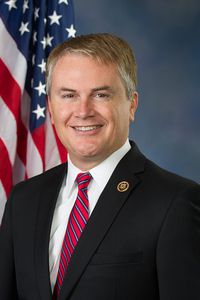
The 2026 general election matchup for Kentucky's 1st Congressional District features incumbent Republican James Comer Jr. facing Democratic challenger Drew Williams. Major election rating outlets consider the seat secure for the GOP, with Cook Political Report and Inside Elections rating it 'Solid Republican' and DDHQ/The Hill and Sabato's Crystal Ball rating it 'Safe Republican.' The race hinges on Comer's high-profile role as House Oversight Committee Chairman and conservative voting record versus Williams' grassroots platform centered on middle-class tax relief, congressional ethics reform, and local community engagement.
The pulse
updated Sep 16Government Accountability, Ethics & Oversight
high salienceComer directs oversight efforts toward executive branch fraud and investigations, whereas Williams focuses on institutional ethics rules like banning congressional stock trading and limiting lobbyist influence.
Democratic Drew Williams
Supports stock bans and ethics reform
Williams advocates for strict financial transparency and government accountability to restore public trust in democratic institutions. He supports real-time public tracking of congressional spending, banning stock trading for members of Congress, and reforming House committee and debate procedures.
- Proposes a total ban on stock trading for members of Congress.
- Calls for real-time public access to congressional budgets, discretionary spending, and staff travel.
- Supports stricter lobbying disclosures and ethics reviews regarding close contacts and business benefits.
“I support stronger transparency laws for congressional budgets, discretionary spending, and lobbying disclosures.”
“I also believe in strict rules around conflicts of interest, stock trading bans for members of Congress, ethics reviews around family or close friend or business benefits, and term limits to reduce self-serving political careers.”
Republican James Comer Jr.
Focuses on executive oversight and anti-fraud
Comer anchors his leadership on aggressive executive branch oversight as Chairman of the House Oversight Committee. He focuses on investigating federal agency fraud, waste, and abuse, as well as high-profile executive branch probes.
- Serves as Chairman of the House Oversight and Accountability Committee.
- Voted for H.Res. 918 to authorize a formal impeachment inquiry into President Joe Biden.
- Voted for the Epstein Files Transparency Act (H.R. 4405) to release unclassified DOJ records.
“As Chairman, Comer is leading some of the most consequential congressional investigations in American history and aggressively advocates for reducing government waste, fraud and abuse.”
Government Spending, Taxes & Economy
high salienceComer emphasizes federal budget balancing, tax relief, and spending cuts, while Williams advocates for middle-class tax restructuring, labor protections, and public investment in rural economies.
Democratic Drew Williams
Supports middle-class relief and labor rights
Williams emphasizes tax policy tailored to everyday Americans, labor dignity, and rural economic innovation. He opposes corporate consolidation and stock buybacks, advocating for reinvestment in local communities and workers.
- Proposes middle-class tax relief and fair compensation initiatives.
- Focuses on rural economic renewal, small business growth, and workplace rights.
- Opposes corporate consolidation and temporary financial fixes at the expense of infrastructure and labor.
“Economically, we’ll need to navigate a world reshaped by automation, climate shifts, corporate consolidation, and rural disinvestment. That means prioritizing meaningful work, infrastructure renewal, and local self-reliance over stock buybacks and temporary fixes.”
Republican James Comer Jr.
Supports spending cuts and tax control
Comer prioritizes controlling federal spending, cutting statutory debt, and enforcing fiscal discipline through constitutional mandates. He signed the Taxpayer Protection Pledge and consistently votes for spending reductions and debt limit restrictions.
- Signed Americans for Tax Reform's Taxpayer Protection Pledge.
- Supports a Balanced Budget Amendment to the U.S. Constitution.
- Voted for the One Big Beautiful Bill Act (H.R. 1, 2025) and Limit, Save, Grow Act of 2023; voted against the American Rescue Plan and Inflation Reduction Act.
“We must get the spending in Washington under control so that we do not saddle our children and grandchildren with unmanageable mountains of debt. This is why I support a Balanced Budget Amendment to the Constitution.”
Term Limits
medium salienceComer committed to a self-imposed 12-year limit in the House, whereas Williams proposes statutory caps of 8 years in the House and 24 years in the Senate.
Democratic Drew Williams
Supports statutory multi-term limits
Williams supports mandatory term limits for both chambers of Congress to prevent long-term political careers. He proposes a limit of 4 terms (8 years) for the U.S. House and 4 terms (24 years) for the U.S. Senate.
- Advocates for a 4-term limit (8 years total) for U.S. House members.
- Advocates for a 4-term limit (24 years total) for U.S. Senators.
“I am in favor of 4 Terms per Chamber, so 8 years (4 terms) for US House, and 24 years (4 terms) for US Senate.”
Republican James Comer Jr.
Pledged self-imposed and constitutional limits
Comer supports term limits for federal lawmakers and pledged a self-imposed 6-term limit (12 years) for himself upon entering Congress. He signed the U.S. Term Limits Amendment Pledge to co-sponsor constitutional limits.
- Pledged a self-imposed term limit of 6 terms (12 years) in the U.S. House.
- Signed the U.S. Term Limits Amendment Pledge to co-sponsor constitutional term limits.
“Our founding fathers never envisioned a Congress where elected officials stayed in office for decades.”
“I support term limits and pledge to take a self-imposed term limit of 6 terms.”
Energy & Environment
medium salienceComer advocates for expanding traditional fossil fuel production and cutting environmental permitting rules, while Williams supports land preservation and transitioning to green renewable energy.
Democratic Drew Williams
Supports conservation and clean energy transition
Williams advocates for land preservation, addressing invasive species, and transitioning toward green, renewable energy. He balances support for current energy needs with environmental stewardship and climate adaptation.
- Expressed interest in the Natural Resources Committee to focus on land preservation and invasive species like carp.
- Supports shifting toward greener and renewable energy and sustainable construction materials.
“...have a healthy respect for both our current needs and productions of fossil fuels while understanding the direction and needs of greener and renewable energy and construction materials going forward”
Republican James Comer Jr.
Supports expanding domestic fossil fuels
Comer favors expanding domestic fossil fuel production and streamlining environmental regulations for energy projects. He opposes federal green energy tax incentives and environmental, social, and governance (ESG) rules.
- Voted for the Lower Energy Costs Act (H.R. 1, 118th Congress) to boost domestic oil, gas, and coal production.
- Voted for H.J.Res. 30 to overturn the Department of Labor rule permitting ESG factors in retirement investments.
- Voted to repeal green energy tax credits in the Limit, Save, Grow Act.
Agriculture & Rural Development
medium salienceComer highlights his career as an active farmer and former state agriculture commissioner favoring deregulation, whereas Williams emphasizes sustainable agriculture and federal investment to fight rural disinvestment.
Democratic Drew Williams
Supports local farm resilience and sustainability
Williams prioritizes local agricultural sustainability, farm resilience, and infrastructure investment in neglected rural areas. He advocates for policies that prevent rural disinvestment and uplift family farm sustainability.
- Lists 'Local Agriculture Sustainability' and 'American Farm Resilience and Renewal' as key platform areas.
- Focuses on rural development, small business support, and fighting rural community neglect.
Republican James Comer Jr.
Supports family farms and deregulation
Comer positions family farms as central to the district's economy and relies on his background as a farmer and former Kentucky Commissioner of Agriculture. He opposes federal regulatory burdens on agricultural operations.
- Served as Kentucky Commissioner of Agriculture from 2012 to 2016.
- Co-owns a 2,000-acre beef cattle, hay, timber, and grain farming operation.
- Opposes federal regulations that burden family farm management.
“Family farms are the backbone of the First District. Owning a successful 2000 acre beef cattle, hay, timber, and grain farming operation, I know first-hand the hard decisions that farmers must make on a daily basis.”
Healthcare & Drug Pricing
medium salienceWilliams prioritizes capping prescription drug costs and reforming health insurance, while Comer voted against federal drug-pricing legislation and favors rolling back federal healthcare mandates.
Democratic Drew Williams
Supports healthcare reform and lower drug prices
Williams highlights community-centered healthcare, insurance reform, and prescription drug price caps. He advocates for reducing healthcare costs for rural families facing tight budgets.
- Includes 'Prescription for Fairness: Fixing Drug Pricing' and 'Healthcare Insurance Reform' in his campaign plan.
- Identifies community-centered healthcare as a primary policy passion.
“Healthcare, housing, and education continue to stretch families too thin — especially in rural areas like the one I call home.”
Republican James Comer Jr.
Opposes federal health mandates and expansion
Comer opposes federal healthcare mandates and voted against broad health and climate spending measures. He voted to roll back federal COVID-19 emergency declarations and travel vaccination rules.
- Voted against the Inflation Reduction Act of 2022, which allowed Medicare prescription drug price negotiations.
- Voted for H.R. 185 to repeal CDC COVID-19 vaccination requirements for foreign travelers.
- Voted for H.J.Res. 7 to end the national coronavirus emergency.
Abortion & Family Values
medium salienceComer takes a firm pro-life stance and opposes funding for Planned Parenthood, whereas Williams focuses on expanding family support systems and childcare networks.
Democratic Drew Williams
Supports family upliftment and childcare network
Williams focuses his family platform on social and financial support systems, including childcare networks and accessibility. He lists 'Family Preparedness & Upliftment' and 'First Year's Childcare Care Network' as platform pillars.
- Proposes a 'First Year's Childcare Care Network' for new parents.
- Advocates for 'Family Preparedness & Upliftment' in rural communities.
Republican James Comer Jr.
Opposes abortion and defunds Planned Parenthood
Comer maintains a 100% pro-life stance, opposes federal funding for Planned Parenthood, and supports traditional marriage definitions. He co-sponsored state constitutional amendments regarding marriage during his time in the state legislature.
- States he is 100% pro-life and opposes federal taxpayer funding for Planned Parenthood.
- Co-sponsored Kentucky's 2005 constitutional amendment defining marriage as between one man and one woman.
“I am 100% pro-life and I oppose gay marriage. While I was a Kentucky State Representative, I cosponsored the 2005 amendment that made same sex marriage illegal in Kentucky.”
Voting Rights & Election Integrity
medium salienceComer supports stricter federal voter verification laws like requiring documentary proof of citizenship, while Williams emphasizes expanding civic participation through formalized public town halls and community surveys.
Democratic Drew Williams
Supports expanding civic participation and town halls
Williams focuses on reforming civic engagement, encouraging grassroots town halls, and modernizing public interaction with government. He opposes political corruption and seeks to expand public input into legislative decisions.
- Proposes formalizing public town halls, courthouse surveys, and expert roundtables.
- Focuses on political corruption and civic engagement reform.
“I want to formalize our public townhalls, issue-driven debates, courthouse surveys, and expert roundtables to get a true understanding and perspective of where our community stands.”
Republican James Comer Jr.
Supports proof of citizenship voting requirements
Comer favors federal voting restrictions aimed at voter verification and citizenship requirements. He opposes federal legislation aimed at expanding mail-in and automatic voter registration.
- Voted for the SAVE Act (H.R. 22) requiring documentary proof of citizenship to register to vote in federal elections.
- Voted against the For the People Act of 2021 (H.R. 1).
Border Security & Immigration
medium salienceRepublican James Comer Jr.
Supports strict border enforcement and deportation
Comer advocates for strict border enforcement, mandatory detention of undocumented immigrants accused of crimes, and increased state authority in federal immigration enforcement. He voted to impeach the Secretary of Homeland Security over enforcement policies.
- Voted for the Secure the Border Act of 2023 (H.R. 2).
- Voted for the Laken Riley Act (S. 5) requiring DHS detention of undocumented immigrants arrested for theft.
- Voted for H.Res. 863 to impeach Homeland Security Secretary Alejandro Mayorkas.
Gun Rights & Second Amendment
medium salienceRepublican James Comer Jr.
Opposes gun control restrictions
Comer is an unwavering supporter of the Second Amendment and opposes federal firearm restrictions. He routinely votes against federal gun control legislation.
- Voted against the Assault Weapons Ban of 2022 (H.R. 1808).
- Consistently voted for gun rights while serving in the Kentucky General Assembly.
“I am unwavering in my support of our 2nd Amendment right to bear arms. During my time in the Kentucky General Assembly, I voted unfailingly to support gun rights and protect the 2nd Amendment.”
Prediction markets 2
updated Sep 16Polymarket ↗
KY-01 House Election Winner
Kalshi ↗
KY-01 House winner?
Prices are the market's latest daily close, expressed as an implied win probability. Follow a source link for live prices and volume.