
2026 Midterms · U.S. House · Georgia Safe D
Georgia — 5th District
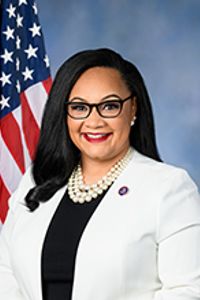

Incumbent Democratic Representative Nikema Williams faces Republican nominee John Salvesen in Georgia's 5th Congressional District general election on November 3, 2026, following primary elections on May 19, 2026. The matchup is a rematch of the 2024 general election, which Williams won with 85.7% of the vote. The race hinges on Williams' record on voting rights, reproductive health, and housing affordability versus Salvesen's platform targeting paper ballots, FDA oversight reform, and resistance to corporate overreach. Major rating bodies—including The Cook Political Report, DDHQ/The Hill, Inside Elections, and Sabato's Crystal Ball—rate the race as Solid Democratic or Safe Democratic, reflecting the district's D+36 Partisan Voter Index.
The pulse
updated Sep 16Voting rights and election administration
high salienceWilliams advocates for federal legislative protections to expand mail-in voting and ease ballot access, whereas Salvesen advocates for dismantling electronic voting machines in favor of paper ballots due to security concerns.
Democratic Nikema Williams
Supports expanding universal ballot access
Williams advocates for federal protections to ensure universal voting access and opposes state-level restrictive voting policies. She has introduced legislation to expand mail-in voting and reduce polling wait times, while voting against federal voter ID and proof-of-citizenship requirements.
- Opposes precinct closures, Exact-Match laws, and voter purges.
- Introduced legislation to reduce poll wait times, expand vote-by-mail access, and guarantee time off for workers to vote.
- Voted NAY on the SAVE Act (H.R. 22) requiring proof of citizenship for federal election registration.
- Arrested at the Georgia State Capitol in 2018 during a protest demanding every vote be counted.
“The precinct closures, Exact-Match laws, broad voter purges, and other unchecked fear tactics must be stopped.”
“I stood peacefully next to my constituents because they wanted their voices to be heard, and now I’m being arrested.”
Republican John Salvesen
Supports replacing electronic voting with paper ballots
Salvesen contends that Georgia's electronic election infrastructure is vulnerable to security breaches. He advocates for replacing the current electronic system entirely with paper ballots to prevent potential hacking.
- Proposes replacing Georgia's existing electronic voting systems with hand-marked paper ballots.
- Maintains that electronic election infrastructure is susceptible to hacking.
“I believe that the election system that we have in place in Georgia is very susceptible to be hacked and should replaced by paper ballots”
Housing affordability and homeownership
high salienceWilliams advocates for federal intervention to ban corporate hedge funds from buying single-family homes, while Salvesen opposes municipal 15-minute city initiatives and cashless systems.
Democratic Nikema Williams
Supports limiting corporate housing ownership and grant funding
Williams focuses on housing affordability and closing the racial wealth gap by curtailing institutional investor purchases of single-family homes. She supports federal grants for low-income home repairs and legislative protections for clear inherited property titles.
- Sponsors the End Hedge Fund Control of American Homes Act to phase out institutional hedge-fund ownership of single-family homes over 10 years.
- Co-sponsors the bipartisan Whole Home Repairs Act establishing grant programs for low- and middle-income home repairs.
- Supports the HEIRS Act to assist families in transferring inherited property titles without formal deeds.
“Middle-class Atlantans are being priced out of the single-family home market by big corporations driving up costs, making purchasing a home unattainable for so many first-time buyers.”
Republican John Salvesen
Opposes 15-minute cities and cash elimination
Salvesen focuses his urban policy stance on resisting 15-minute city concepts and defending cash transactions. He views municipal urban planning shifts and digital currency trends as undesirable control measures.
- Opposes urban planning concepts centered on 15-minute cities.
- Opposes the elimination of cash and what he describes as the digitization of Georgia.
“I am strongly against any attempts at 15 minutes cities and the elimination of cash. AKA what nikima calls the digitization of Georgia”
Healthcare and reproductive rights
high salienceWilliams emphasizes statutory protections for abortion rights and targeted federal grants for community health programs, whereas Salvesen expresses general support for reasonable healthcare without specifying policy mechanisms.
Democratic Nikema Williams
Supports federal abortion rights and community healthcare expansion
Williams advocates for federal protections for reproductive rights and expanding health access to resolve racial health disparities. Drawing on her executive background at Planned Parenthood, she leads legislative initiatives for specialized women's health research and community-based care.
- Authored the Health Access Innovation Act funding faith and community organizations to address health disparities.
- Co-chairs the Bipartisan Congressional Endometriosis Caucus advocating for expanded research and treatment access.
- Voted YEA on the Inflation Reduction Act permitting Medicare prescription drug price negotiations.
“Reproductive rights are human rights.”
Republican John Salvesen
Supports reasonable healthcare access
Salvesen identifies reasonable healthcare access for Americans as one of his primary public policy passions.
- Cites reasonable healthcare for Americans as a core public policy priority.
“I'm personally passionate about reasonable Healthcare for Americans”
Government governance, transparency, and reform
medium salienceSalvesen focuses on structural institutional reform through strict self-imposed term limits and weekly constituent podcasts, whereas Williams exercises oversight through legislative votes for executive transparency and House leadership accountability.
Democratic Nikema Williams
Supports government transparency and legislative accountability
Williams has voted for high-profile executive branch disclosure bills and participated in House leadership accountability votes, including voting to vacate the House speakership and to release investigative files.
- Voted YEA on the Epstein Files Transparency Act (H.R. 4405) requiring DOJ publishing of unclassified records.
- Voted YEA on H.Res. 757 declaring the office of Speaker of the House vacant in October 2023.
Republican John Salvesen
Supports congressional term limits and financial transparency
Salvesen advocates for constitutional term limits across federal offices and pledges to serve no more than two terms in Congress. He emphasizes absolute financial transparency and regular constituent communications.
- Supports term limits of two terms for President and Senate, and four terms for House representatives.
- Pledges personally to serve no more than two terms in the U.S. House.
- Commits to weekly constituent updates via podcast and strict anti-bribery standards.
“Personally I will only serve two terms. After that I will either run for president or I will go back to being a handyman”
Immigration and border security
medium salienceDemocratic Nikema Williams
Opposes restrictive immigration enforcement measures
Williams consistently votes against conservative immigration and enforcement legislation. She opposed measures mandating federal detention for noncitizens arrested for theft, mandatory deportation for DUI offenses, and broader border restriction bills.
- Voted NAY on the Laken Riley Act (S. 5) requiring DHS detention for noncitizens arrested for burglary or theft.
- Voted NAY on H.R. 875 making driving under the influence grounds for noncitizen deportation.
- Voted NAY on the Secure the Border Act of 2023 (H.R. 2) and the impeachment of Secretary Alejandro Mayorkas.
Education and student support
medium salienceDemocratic Nikema Williams
Supports public school funding and student assistance programs
Williams supports fully funding public schools, defending the U.S. Department of Education against spending cuts, and aiding higher education students. She advocates for college access programs for first-generation students and food assistance expansion on college campuses.
- Supports Federal TRIO Programs serving low-income and first-generation college students.
- Introduced the Overcoming Higher Education Hunger Through the Supplemental Nutrition Assistance Program Act.
- Opposes proposed structural cuts or elimination of the U.S. Department of Education.
“Public education is absolutely critical to fulfilling the promise of every young person, and I will continue to fight against the destruction of our schools tooth and nail.”
Food safety and FDA oversight
low salienceRepublican John Salvesen
Supports stricter FDA regulations on food ingredients
Salvesen criticizes current Food and Drug Administration regulation, arguing the agency permits harmful ingredients into the national food supply.
- Argues the FDA fails to properly restrict unsafe ingredients in American food products.
- Calls for reforming FDA approval standards.
“I believe that there is ingredients in our food that should never be passed by the FDA and I don't think they're doing their job properly”
Care infrastructure and social welfare
low salienceDemocratic Nikema Williams
Supports federal care infrastructure and paid leave
Williams views accessible caregiving as essential economic infrastructure. She introduced legislation to integrate childcare planning into economic development and supports federal paid family and medical leave.
- Introduced the Care is an Economic Development Strategy (CEDS) Act requiring local development districts to plan for expanded childcare.
- Supports federal funding for paid family and medical leave and elder care.
- Voted YEA on the Social Security Fairness Act of 2023.
Prediction markets 2
updated Sep 16Polymarket ↗
GA-05 House Election Winner
Kalshi ↗
GA-05 House winner?
Prices are the market's latest daily close, expressed as an implied win probability. Follow a source link for live prices and volume.